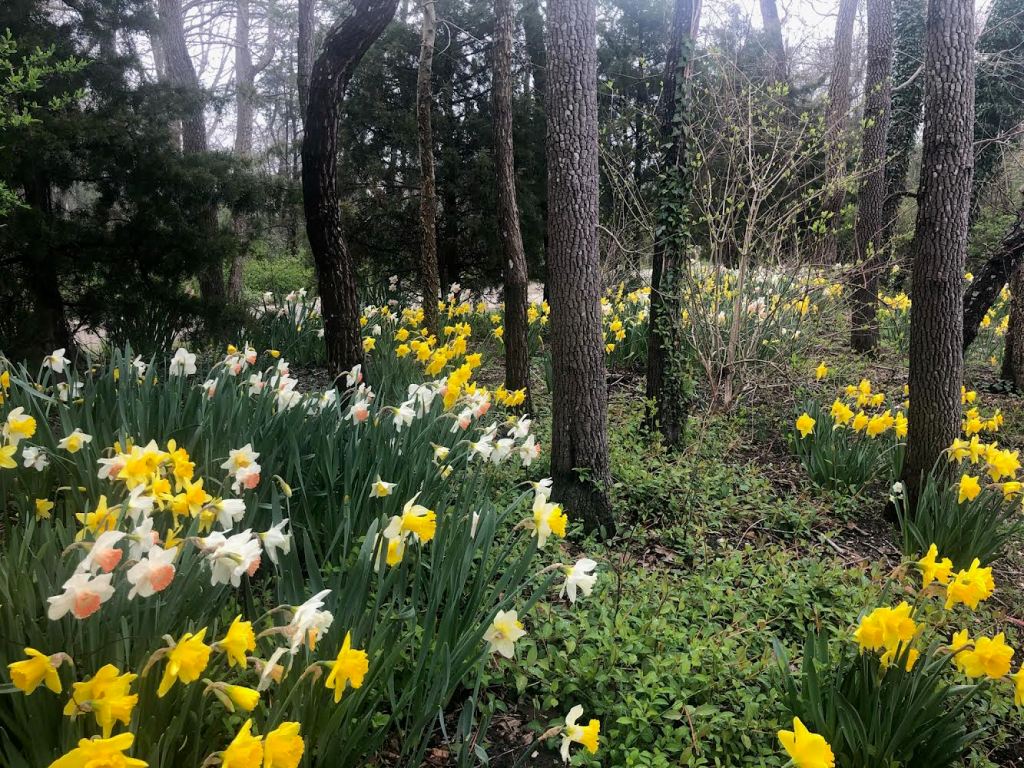


Sawako Furuno and her husband, Mansur Khawar, arrived at their wooded lot on Raycliffe Drive on a quiet Sunday evening in April expecting to find the same peaceful parcel of land they bought in 2019—untouched, overgrown, still waiting for the dream home they planned to build.
Instead, several trees were gone, and the land was noticeably cleared. A pink ribbon signaled something was wrong.
“We drove up and then we found the land clear-cut,” Furuno said. “We were walking through the land thinking, that is really weird.” They assumed a maintenance worker for Raycliffe Drive—a private road winding up Overlook Mountain protected by the town’s scenic overlay district zoning laws—had kindly cleared some trees.

Furuno, an architect and cycling fashion entrepreneur, and her partner Khawar, a consultant in private equity, and their two children, spend most of the year in London. They plan to eventually build a family home on Raycliffe Drive in Woodstock. After noticing the missing trees, they drove to a neighbors house to say hello.
“The doorbell rang on a Sunday morning,” said neighbor Ira Nerenberg, an architect who has lived on Raycliffe Drive since 2012. “And my wife answered the door and said, ‘Sawako, it’s so great to see you. What are you doing here? We thought you sold your property.’ And they said, ‘What? We didn’t sell the property.’ And that was sort of the beginning.”
That moment triggered a weeklong spiral of revelations, phone calls, and disbelief: Furuno and Khawar had not sold the land. But according to Ulster County land records, someone else had—using falsified documents and fake passports bearing Khawar and Furuno’s names.
The fraudulent deed was filed on August 30, 2024, transferring ownership of the Raycliffe Drive parcel to Jordan Levine of Melville, N.Y., for $360,000, with the transaction handled by attorney William Myers of Saugerties. A notary seal from the U.S. Embassy in London appears on the deed, falsely attesting that Furuno and Khawar had appeared in person to sign over the land.

The man who purchased the property, Jordan Levine, who declined to comment for this story, was said—by Furuno—to be devastated when informed of the fraud. According to Furuno, Myers said the sellers had never appeared in person, and the documents, including photo IDs, were submitted digitally.
“I don’t even have a British passport,” Furuno said. “But they created a British passport just using my name, passport number, date of birth. Nothing is correct.”
The couple reported the crime to Woodstock Town Supervisor Bill McKenna, and Woodstock Police. In a phone interview, McKenna acknowledged a troubling pattern: on the same day, two other Woodstock property owners contacted him to report that their vacant parcels were listed for sale—without their consent. McKenna reached out to the Ulster County Board of Realtors and referred the landowners to state police. “They’re targeting vacant land,” McKenna told the Overlook.
The couple then reported the fraud to the New York State Police in Kingston, who confirmed an ongoing criminal investigation over the phone. No suspects have been named.
In an emailed statement, Myers said he was “made aware of an allegation of fraud in connection with the sale of local real estate,” and that “a police investigation has been commenced at my request.” He declined to comment on specifics, citing the early stage of the investigation, but expressed confidence that “the matter will be resolved to the satisfaction of the individuals involved due to certain safety protocols being in place.”
“This could tie up in court for years,” said Jonharold Cicero, a real estate attorney at DL Partners in New York City. “Most are eventually resolved through a settlement between the insurer, the defrauded buyer, and the rightful owner.”
Myers noted the growing prevalence of real estate-related scams. “Allegations of fraud by various methods are increasing,” he said, citing “wire fraud, identity theft, impersonating family members in order to steal money, bank fraud, [and] telemarketing scams” as examples.
Marc W. Miller, a Kingston-based attorney specializing in real estate law, described methods owners could employ to protect themselves. “One way is to buy land through a mortgage from someone you trust,” Miller said. “Another approach is to buy property through an LLC, providing a certain level of protection since LLC documents typically require specific procedures for any sale. However, even that can be vulnerable. There was a recent scam where highly skilled scammers duplicated a title company’s website, directing escrow payments into fraudulent accounts.”
Asked if real estate agents and lawyers should exercise greater due diligence, Miller replied, “I would agree with that, yes.”
The fraudulent sale wasn’t a simple bureaucratic error but a case of identity theft and real estate fraud, revealing gaps in the land title system and raising broader concerns about how easily such schemes can unfold.
According to the filed real property transfer report, the land was described as “residential vacant land,” with no mortgage or subdivision approval needed. As of April 25, it appears land records pertaining to the parcel were removed from the county’s online land record database.
“We just feel really completely violated,” Furuno said. “These fake passports are really almost hilarious—but it’s terrifying.”

Real estate experts say scams involving vacant land are increasingly common. “With no home to inspect, no in-person closing, and no obvious occupants, it’s easier for fraudsters to slip through unnoticed,” said Miller, who has specialized in real estate and property law in the Hudson Valley for over 40 years. “They often rely on absentee owners, fake IDs, and mail-in transactions.”
Ulster County Acting Clerk Taylor Bruck explained that his office is legally required to file any technically sufficient document—even if fraudulent. “We don’t verify that the person submitting it is the actual owner,” he said. Filing a deed, Bruck noted, does not itself transfer ownership; it simply initiates a process managed by the state’s real property system. He added that accepting and recording even a fraudulent deed can serve a purpose, creating a paper trail that may help victims in court. “If we just rejected it, we wouldn’t know it was fraudulent—and the courts wouldn’t have that as evidence,” he said. Bruck encouraged residents to enroll in the county’s land fraud alert system, which sends notifications when a deed is recorded.
McKenna instructed the town’s building inspector to see if any violations of the town’s scenic overlay district zoning code were present without a permit. “I asked our building assessor to go up there and place a stop work order if any code was infringed,” he said. He confirmed that there were no violations.
Still, McKenna informed Jordan Levine’s attorney that no permits would be issued by the town while the matter remains unresolved.
Fidelity National Title Insurance Company, which underwrote the sale to Levine, may now be responsible for untangling the dispute. A spokesperson for the insurance company declined to comment. As did Ron Knowles, the real estate sales person for Century 21 Real Estate associated with the fraudulent sale. Knowles did confirm that he met with state police and shared information with investigators.
Still, Furuno worries about long-term damage— to Jordan Levine, to her family’s peace of mind, and to other land-owners who might fall victim to this scam.
“We’re still trying to figure out how to get our land back,” Furuno said. “And we’re constantly scared that somebody might be doing the same thing to someone else.”
In response to rising concerns statewide, a law co-authored by Attorney General Letitia James went into effect on last year, officially classifying deed theft as a crime in New York. The law grants the Attorney General’s Office original jurisdiction to prosecute these cases and extends the statute of limitations, allowing more time for victims and prosecutors to act. The legislation also empowers authorities to invalidate fraudulent sale and loan documents and stay evictions linked to suspected deed theft.
In Furuno and Khawar’s case it is unclear what the current legal status of their land is.
If you have experienced a similar situation or suspect you may be a victim of deed theft, contact the New York Attorney General’s Office by calling 1-800-771-7755, emailing deedtheft@ag.ny.gov, or filing a confidential complaint online.
If you have experienced a similar situation or have information about real estate fraud, please contact tips@theoverlooknews.com.
Noah Eckstein is the editor-in-chief of The Overlook. Send correspondence to noah@theoverlooknews.com.