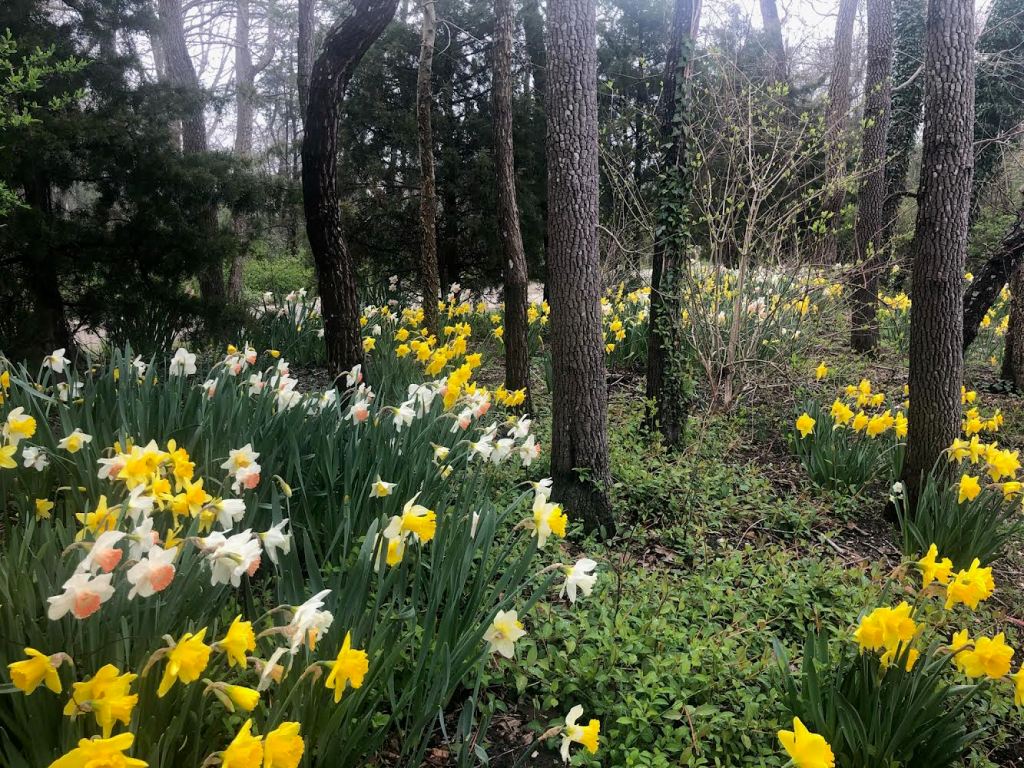


The light in the woods has changed abruptly. Last week, the trees and shrubs still wore their bright, light-green spring coats, a sign of the nitrogen-rich land suffused with life. Now, with heat and rain—voilà!—the forest is shrouded in the cool, dark green of summer. The canopy has filled in, mysteries hidden beneath mother nature’s verdant mantle.
This is the very definition of fecundity. Here’s just a sample of what’s happening now and what’s yet to come.
Florid Flora
This season never ceases to amaze us. Nor should it.
The early spring ephemerals—Dutchmen’s breeches, wood anemones, spring beauties, purple trilliums, trout-lilies—have quickly given way to late-spring blooms: brown and green jack-in-the-pulpits, Canada mayflowers (wild lily-of-the-valley), and starflowers.
Strong winds have finally knocked down last year’s beech leaves, which clung through winter like old soldiers. Now, forest leaves leap from branches and limbs. Ephemerals thrive in the open light of early spring—light that reaches the forest floor before the canopy closes (a time that also poses brush-fire risks as last year’s leaf litter dries out).
Some plants, like partridgeberry and lycopodiums—ground cedar, tree wort and club moss—grow year-round on long runners. Others emerge now, adapted to the dim understory of summer—if they survive over-browsing by white-tail deer.
The moccasin flower, or pink lady’s-slipper, is up in its secret places. False Solomon’s seal is common, while the rarer true Solomon’s seal hangs delicate white bells. Ferns flourish: sensitive fern (which indicates wet ground), hay-scented fern, New York fern (pointed at both ends, like New Yorkers who don’t know whether they’re coming or going), and many more.
As spring shifts to summer, the flower show moves to sunnier fields and meadows. Some field blooms are already out—bluets by the bucket, forget-me-nots, cinquefoil, mallow, honeysuckle, multiflora rose, raspberry, wintercress (yellow rocket), chickweed, wild strawberry, dame’s rockets (often confused with phlox), and long-stem buttercups. Beebalm, goldenrod, and ragweed will arrive soon.
This looks to be a great year for heath plants: lowbush and highbush blueberries, wild azaleas, and mountain laurel—the official flower of Woodstock. Mountain laurel, beautiful and highly toxic, is outgrowing other heaths and may bloom mid-month.
Poison ivy (“leaves of three, let them be”) thrives along the edges of forests and fields and is spreading rapidly, adapting to longer warm seasons. It is now the first native plant officially declared invasive. Its natural antidote, jewelweed, often grows nearby.
Locust trees are blooming visibly now. The tulip tree’s flowers are harder to spot high above, but you might find fallen petals below.
Fawning Fauna
Butterflies are returning—captains, viceroys, skippers, sulphurs, tiger swallowtails, whites—and so are moths and dragonflies. Fireflies are here too, though still few in number. Lawn chemicals may be affecting their populations. It’s early yet and more may come.
Bee numbers remain low, which is disheartening. Milkweed is sprouting, preparing for its midsummer rendezvous with young monarchs flying north from Michoacán. Their epic journey and symbiotic bond with milkweed is nothing short of miraculous.
Another incredible migrator, the ruby-throated hummingbird, flies 2,000 miles from Central America, including a 500-mile flight over the Gulf of Mexico. Though some birds travel farther, none match the hummingbird’s combination of distance, efficiency, and endurance. They survive on nectar and insects, weathers storms, dodges wind turbines, and still find their way to nest, often in the same spot for thousands of years. These fearless birds will even challenge larger species for territory.
If you feed them, use only white sugar and water—no dye. Keep feeders clean and away from cats.
White-tail deer have given birth to their spotted fawns. If you find one alone in the grass, do not touch. The mother is likely nearby (see my May note, Green Light, for more). By contrast, bird eggs or nestlings can be returned to the nest. You’ll be a hero.
New life is everywhere now, and though it may feel overwhelming, it’s a joy to witness the rising tide of green, pulsing life. It’s a gift to feel the warm sun, clear cool waters of the Sawkill, the rain-fed creek massaging this older, tempered body. The water tumbles over ledges and past hidden trout, whispering primordial memories, bound for the Hudson and ocean, then back again as future rain.
We focus on the forest and field, but the riparian corridors—the life of our streams—are just as rich and vital.
Endless June
June days begin early—sunrise around 5 a.m.—as if the world knows there’s much to do. With almost 15 hours of daylight, we approach the magical midsummer solstice (Friday, June 20, at 10:41 p.m.), the year’s longest day.
June moves gently. Insects rise sluggishly from the cool night. It’s a generous, flowering month—the culmination of spring and the foundation of summer’s abundance.
Growth surges now, laying the groundwork for July and August’s bounty. Yet June seldom gets credit for it. Perhaps it doesn’t need it. June is content to be one of the most gloriously beautiful times.
Birdsong fills the air as some sing for the first time, crooning like forlorn lovers, wooing a mate, singing as if the tune was written for this moment alone.
People often think nature exists for their enjoyment. But spring happened long before us and will likely continue long after. Leaves unfold to gather light, not to please us. The shade and beauty they offer are incidental. Their blooms attract pollinators, not poets, although countless writers, myself included, have claimed otherwise.
Every form of life is increasing now. Plants, animals, even fungi all join the grand bandwagon of summer. It’s a wild ride called life. Thank you for sharing the journey with me.
Please enjoy a safe and joyful season.
“Ranger” Dave Holden is a New York State DEC-licensed hiking guide. Send correspondence to
woodstocktrails@gmail.com.